Japanese everyday meals look great. Recommendation for using Vietnamese traditional pottery "Song Be ware" as everyday dishes
Xin Chào! This is Meg from ít ít Việt Nam.
Souvenir pottery from Southern Vietnam, called "Song Be ware," is adored for its rustic floral and bird paintings and charmingly plump, warm appearance. Have you ever found yourself thinking "How cute!" when you spotted it locally, only to have these worries pop into your head?
"Won't such an Asian design look out of place on a Japanese dinner table...?"
"It looks delicate, so it might not be suitable for everyday use..."
Actually, that's not true at all!
This time, focusing on Nang Ceramics' tableware, we'll introduce the joy of using Song Be ware for everyday meals, which can instantly transform your usual Japanese home cooking.
In fact, it's the perfect tableware for "curry" and "Japanese food"

The most distinctive feature of Song Be ware is its gentle, slightly faded yellow and green colors, hand-painted one by one by artisans. This surprisingly matches Japanese home cooking.
For example, your usual "home curry." Just serving it in a plump deep dish of Song Be ware transforms it into a special dish, like a nostalgic, stylish retro café menu.
Moreover, putting omurice, or fried eggs and toast for breakfast, on a Song Be ware plate immediately makes you feel excited, as if you're starting a morning abroad.
Despite its unfamiliar shape, the "oval plate" fits surprisingly well into Japanese dining

Among many round Asian dishes, the oval plate stands out with its somewhat unusual presence. Originally, this shape was influenced by the French colonial period, so it tends to be avoided with the thought that "it's stylish, but might not fit well with Japanese dining."
However, this shape is actually a versatile player that is surprisingly useful for everyday Japanese meals!

For example, arranging everyone's favorite "gyoza" or placing a "grilled fish" on it surprisingly fits beautifully. Come to think of it, the silhouette is very similar to the plates often used for grilled fish in Japan. You can also elegantly arrange "sashimi" with a little space left, or serve carpaccio, which instantly elevates your usual side dishes. It's a hidden gem of a plate that blends seamlessly with both Japanese and Western cuisine, truly handy to have one.
Popular but how to use? The beloved history and size-specific uses of "rimmed plates"

Among Song Be ware, the item our Japanese customers most frequently ask "How do I use this?" about is the "rimmed plate," which has a raised edge.
This shape actually has a very charming historical background. Originally, Vietnamese pottery originated in the north, but unlike the south, the north is not warm all year round; there are often rainy and cold periods, and historically, food harvests were unstable. In an era when rice and meat were so precious they could only be eaten once a month, it is said that this rimmed shape became popular as a wisdom of daily life, to make "even a small amount of side dishes appear plentiful and rich through the magic of the tableware."
Despite being filled with such kindness and history, rimmed plates prove to be surprisingly versatile and highly useful in modern Japanese dining!

■ Smallest size (like a small bowl)
It can be used exactly like a Japanese "kobachi" (small bowl). Just by serving a small amount of classic Japanese dishes such as ohitashi, hiyayakko, or hijiki no nimono, it surprisingly looks as stylish as a high-end restaurant. It's also the perfect size for serving tea snacks like arare or candies, or a small portion of dried fruits from Vietnam.
■ Medium-sized plates (for main dishes and pasta)
Of course, it's great for serving salads, but if you neatly coil cold pasta in the center, it looks incredibly cute, like something from a restaurant! With its suitable depth, it also looks stylish when serving slightly saucy dishes like soup pasta or stewed dishes.
■ Largest size (for stews and soups)
It pairs perfectly with Japanese stews like "Nikujaga" or "Chikuzenni," which tend to be brownish from soy sauce and mirin! The green and floral patterns painted on the rim of the dish gently add color. Large rimmed plates are also very compatible with saucy dishes, so you can generously use them for dishes with plenty of liquid.
💡 Even better! Two more reasons to recommend rimmed plates
- Excellent stackability, saving space in your cupboard Don't cute overseas plates often seem hard to stack? These rimmed plates are designed so that they can be stacked neatly and securely. They fit beautifully and tidily into the limited space of Japanese kitchen cupboards, making them truly convenient for tidying up.
- A small rim naturally "brightens up" everyday meals The slight rim (step on the edge) of the plate naturally creates beautiful "empty space" when food is served in the center. This acts like a picture frame, making your ordinary everyday dishes look surprisingly elegant and significantly more vibrant.
Proof of reliability. "Microwave and dishwasher safe" verified by Japanese inspection agencies 💡
While traditional foreign pottery is often thought to be unsuitable for microwaves and dishwashers, the modern New Song Be ware we select is different.
Surprisingly, we have submitted our products to Japanese inspection agencies for testing and they have passed tests for safe use in both microwaves and dishwashers.
Q. Can it be used in a microwave?
Yes, it can be used perfectly! Being able to pop cold side dishes or rice directly into the microwave and reheat them in the same dish is incredibly convenient for anyone managing daily meals. Feel free to use it just like your usual plates.
Q. Is it safe to put in a dishwasher?
Yes, you can use it in the dishwasher without any issues! Its moderate thickness and toughness make it easy to wash with gusto, which is a great appeal. Busy post-meal clean-up can be handled smartly by leaving it to the dishwasher.
Another story born from pottery. Broken fragments transformed into wearable accessories.
While Song Be ware fits seamlessly into modern Japanese life, there's a somewhat poignant backstory to its journey to our hands.
Even today, Song Be ware is still hand-painted one by one by artisans using traditional "wood-fired kilns." Due to the delicate nature of this traditional manufacturing method, combined with the unstable and still-developing local delivery services in Vietnam, approximately 10% to 15% of the plates would inevitably be discarded due to cracks or breakage during transport from the kilns.

Each piece, with its unique, beautiful painting, crafted with the artisans' heart and soul.
"It's too sad to simply throw these away just because they're broken..."
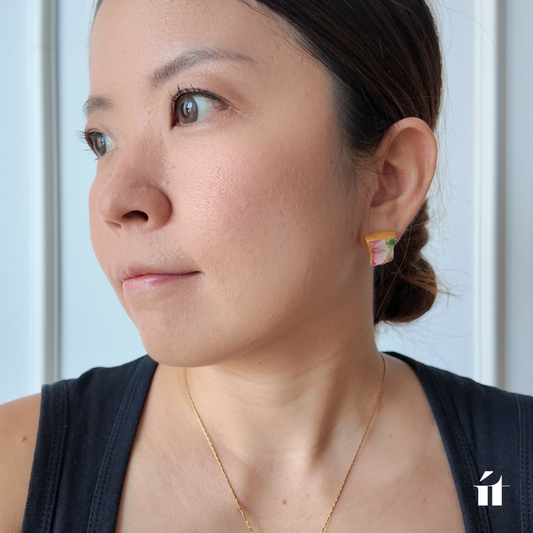
With this sentiment, we at ít ít Việt Nam carefully cut the discarded plate fragments, apply the traditional Japanese technique of "Kintsugi" (gold joinery), and upcycle them into one-of-a-kind earrings, clip-on earrings, and necklaces.

Though they couldn't fulfill their life as tableware, they are reborn as jewelry, transforming their shape to beautifully adorn your ears and neck. We hope you'll come to our store and experience this "other story" of our dishes.
Imperfect, therefore beloved. Your unique piece.

Unlike modern mass-produced uniform tableware, Song Be ware has firing irregularities and slight distortions inherent to handcrafted items. Even small scratches acquired along the way are part of its beloved story.
It is precisely this "imperfection" that gives it a comforting warmth when placed on the dining table.
At ít ít Việt Nam's Ho Chi Minh City and Hoi An stores, we offer a wide selection of Song Be ware that gently blends into everyday Japanese dining, and unique Kintsugi accessories born from these very dishes.
Please come and find your favorite piece that will make your everyday life a little more special.
All our staff look forward to welcoming you to our cool store! ♡
ít ít Việt Nam Store Information 📍
Ho Chi Minh City Store: Right by Ben Thanh Market!

-
📍3rd floor, 14 Đ. Nguyễn An Ninh, Bến Thành, Quận 1, Ho Chi Minh City, Vietnam
→Google Map
⏰10:00 AM – 5:00 PM
🚶2-minute walk from Ben Thanh Market
💳Cash and credit cards accepted
Hoi An Store: While strolling through the Old Town

-
📍567 Đ. Hai Bà Trưng, Phường Minh An, Hội An, Quảng Nam
→Google Map
⏰10:00 AM – 6:00 PM
🚶Approx. 10-minute walk from Hoi An Japanese Bridge
💳Cash and credit cards accepted
- See the latest items on Instagram
Our entire staff looks forward to seeing you in Vietnam! ♡