The "memory of rice" held in Bia Hoi glasses. The reason why black spots become endearing.
Xin chào! I'm Meg from ít ít Việt Nam.
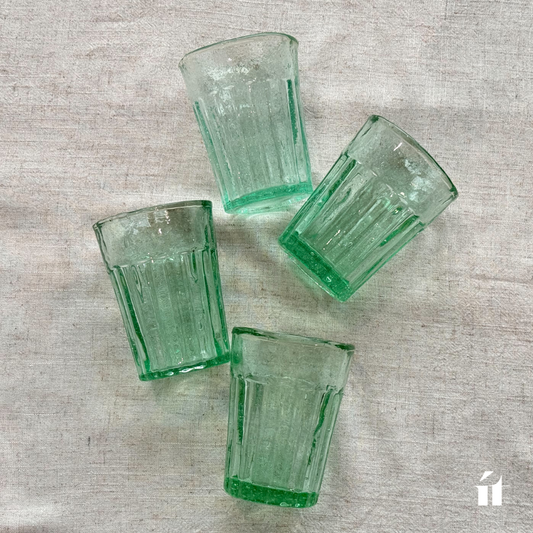
Recently, our shop started carrying Hanoi's "Bia Hoi glasses." As I was excitedly inspecting each of the many charming glasses that arrived, I suddenly noticed what looked like a black stain inside one of them.

Honestly, at first, I was disappointed, thinking it might be a defective product. But as it kept bothering me, I spoke with the craftsman at the factory, and they told me that behind this black speck was a wonderful story unique to Bia Hoi glasses.
A cycle unique to Vietnam, a rice-producing nation

Vietnam boasts one of the highest rice consumption rates in the world. From pho for breakfast to rice for dinner, rice is truly a lifeline. Because of this deeply rooted rice culture, the "rice leaves, stalks, and straw" after harvest were also valuable resources for the Vietnamese people.
"Rice Straw" that breathes life into coal
To make Bia Hoi glasses, coal must first be intensely burned to melt the glass into a molten state. However, coal is not something that can be easily ignited with just a match.

That's where the craftsmen use the "rice leaves, stalks, and straw" that have served their purpose and been discarded. They set these on fire and slowly transfer their heat to the coal. This is a traditional method of making fire, unique to Vietnam, the land of rice.
"Rice Ash" trapped in the glass
The true identity of those small black specks you see when you hold a Bia Hoi glass up to the light? They were "rice ash" used to burn the coal.
While the fire was burning, some ash floated up, stuck to the superheated molten glass, and got trapped there. The black specks I thought were "stains" were actually a "testament" to the heat of the moment the glass was born and the life of the rice within it.
Packaging, too, with rice
What surprised me even more was the old packaging method. It is said that in the past, when Bia Hoi glasses were transported, dried rice stalks and leaves were used as cushioning material to carefully wrap and carry them.

Ignited by rice, adorned with rice ash, and protected by rice, they arrive at your hands. Bia Hoi glasses are truly glasses born from the very nature of Vietnam.
These black specks do not affect the quality of the glass in any way. But once you know the reason, don't these uneven patterns suddenly seem very endearing?
Learning the story behind the manufacturing process and enjoying its characteristics. I believe that such a way of appreciating things is one of the joys of Vietnamese craftsmanship.

If you find "memories of rice" in the glass in your hand, please recall the craftsman's back in distant Hanoi. Your usual drink will surely feel just a little bit gentler.
Access ít ít Việt Nam here 📍
You can check our store's detailed location and the latest lineup from the links below.
-
Check location on Google Maps
-
Ho Chi Minh City store here
📍3rd floor, 14 Đ. Nguyễn An Ninh, Bến Thành, Quận 1, Ho Chi Minh City, Vietnam
⏰10:00 AM – 5:00 PM
🚶2 minutes walk from Ben Thanh Market
💳Cash and credit cards accepted
-
Hoi An store here
📍567 Đ. Hai Bà Trưng, Phường Minh An, Hội An, Quảng Nam
⏰10:00 AM – 6:00 PM
🚶Approximately 10 minutes walk from Hoi An Japanese Covered Bridge
💳Cash and credit cards accepted
-
Ho Chi Minh City store here
- See latest items on Instagram
Our staff looks forward to seeing you in Vietnam!